




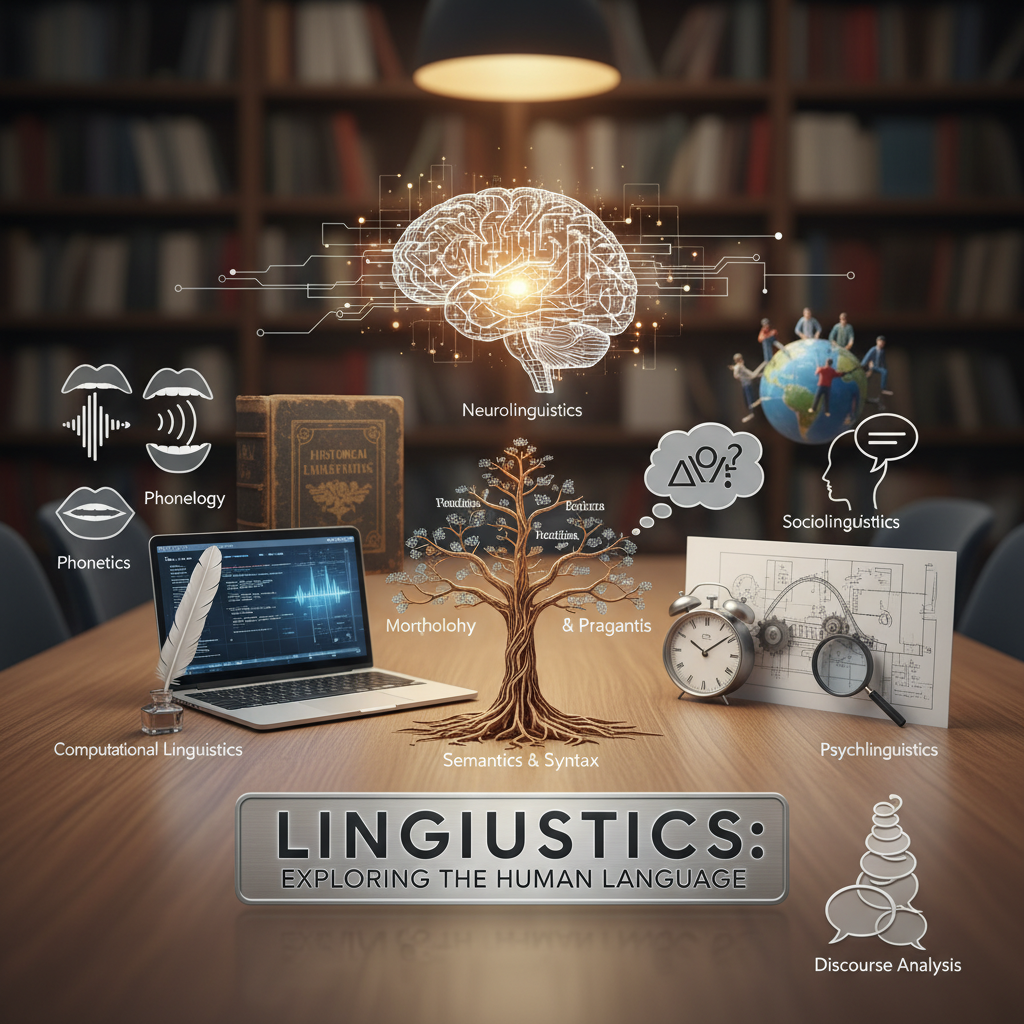
A growing body of research published in late 2024 and 2025 suggests that large language models (LLMs) are not only transforming natural language processing applications but also reshaping the theoretical foundations of computational linguistics itself. Researchers from institutions including Stanford, MIT, and the Allen Institute for AI have begun documenting how transformer-based systems are forcing linguists to reconsider long-held assumptions about syntax, semantics, and language acquisition — a shift that some scholars argue represents the most significant methodological pivot in the field since the statistical revolution of the 1990s.
The debate has intensified in recent months as new benchmarks reveal that models such as GPT-4, Claude, and Gemini can perform sophisticated linguistic analysis tasks — including parsing low-resource languages, identifying rare morphological patterns, and generating grammaticality judgments — at levels that often rival trained human annotators. According to proceedings from the Association for Computational Linguistics, more than a third of papers presented at recent ACL conferences now examine how LLMs can serve not just as engineering tools but as testable hypotheses about how language might be represented and processed.
From Rule-Based Systems to Emergent Grammar
For decades, computational linguistics was dominated by the Chomskyan tradition, which held that grammatical competence required innate, rule-based structures. Statistical and neural approaches challenged this view, but transformer architectures have accelerated the disruption. A widely discussed paper from researchers at Stanford’s Computer Science Department demonstrated that LLMs trained purely on next-token prediction develop internal representations remarkably similar to syntactic dependency trees — without ever being explicitly taught grammar.
“What’s striking is that these models are deriving structure from distribution alone,” said Dr. Christopher Manning, a leading figure in the field, in a recent lecture series. The finding has reignited the long-running poverty-of-the-stimulus debate, with some linguists arguing that LLMs prove statistical learning is sufficient for grammatical competence, while others counter that the sheer scale of training data — often trillions of tokens — bears no resemblance to the linguistic input available to a child.
Low-Resource Languages and Documentation
One of the most consequential developments concerns endangered and low-resource languages. Recent collaborations between computational linguists and indigenous language communities have produced new toolkits that combine LLM capabilities with traditional fieldwork methods. The Ethnologue database currently catalogs more than 7,000 living languages, of which roughly 40% are considered endangered. Researchers at the University of Hawaiʻi and elsewhere are now using fine-tuned models to accelerate the creation of dictionaries, grammars, and pedagogical materials for languages that have historically lacked digital infrastructure.
Critics, however, warn that the technology can introduce errors that are difficult for non-specialists to detect. A 2025 review article noted that LLM-generated grammatical descriptions for under-documented languages frequently hallucinate plausible-sounding but incorrect paradigms, particularly in agglutinative and polysynthetic systems. The consensus among field linguists is that these tools are valuable accelerators but cannot replace native-speaker expertise or careful philological work.
Methodological Tensions in the Field
The rapid integration of LLMs has also produced friction within academic departments. Traditional theoretical linguists have expressed concern that graduate programs are increasingly oriented toward engineering benchmarks rather than fundamental questions about human cognition. Meanwhile, computational researchers argue that empirical performance is itself a form of theoretical evidence. Funding agencies, including the National Science Foundation, have begun explicitly soliciting proposals that bridge these communities, signaling institutional recognition that the divide is unsustainable.
Looking ahead, the next twelve months are likely to bring further consolidation. Several research groups are preparing large-scale evaluations of multilingual models on typologically diverse languages, and new interpretability techniques promise to reveal more about what LLMs actually encode. Whether these systems ultimately serve as models of human language or merely as powerful tools for analyzing it remains an open question — but the line between the two is blurring faster than most researchers anticipated.
For more on the science behind language, cognition, and emerging technologies, visit science.wide-ranging.com for related coverage and in-depth analysis.