




The practical application of nudge theory plays an important role in shaping better decisions, improving user behavior, and encouraging positive choices across many areas of life, including public policy, healthcare, finance, education, marketing, workplace design, environmental action, and everyday personal habits. Nudge theory is based on the idea that people do not always make decisions through careful reasoning alone; instead, their choices are often influenced by context, timing, convenience, social norms, default options, and the way information is presented. By making subtle, ethical adjustments to the decision-making environment, organizations and policymakers can help guide individuals toward actions that are likely to benefit them, while still preserving their freedom to choose differently.
In public policy, nudges can be used to increase voter registration, encourage tax compliance, promote recycling, or improve participation in public programs by simplifying forms, sending timely reminders, or making beneficial options easier to access. In healthcare, nudge theory can support better outcomes by reminding patients to take medication, encouraging preventive screenings, designing clearer food labels, or making healthier meals more visible and convenient in cafeterias. In finance, automatic enrollment in savings or retirement plans is a well-known example of a nudge, because it helps people save for the future without forcing them to participate. In education, nudges such as progress alerts, goal-setting prompts, and supportive feedback can motivate students to complete assignments, attend classes, and stay engaged.
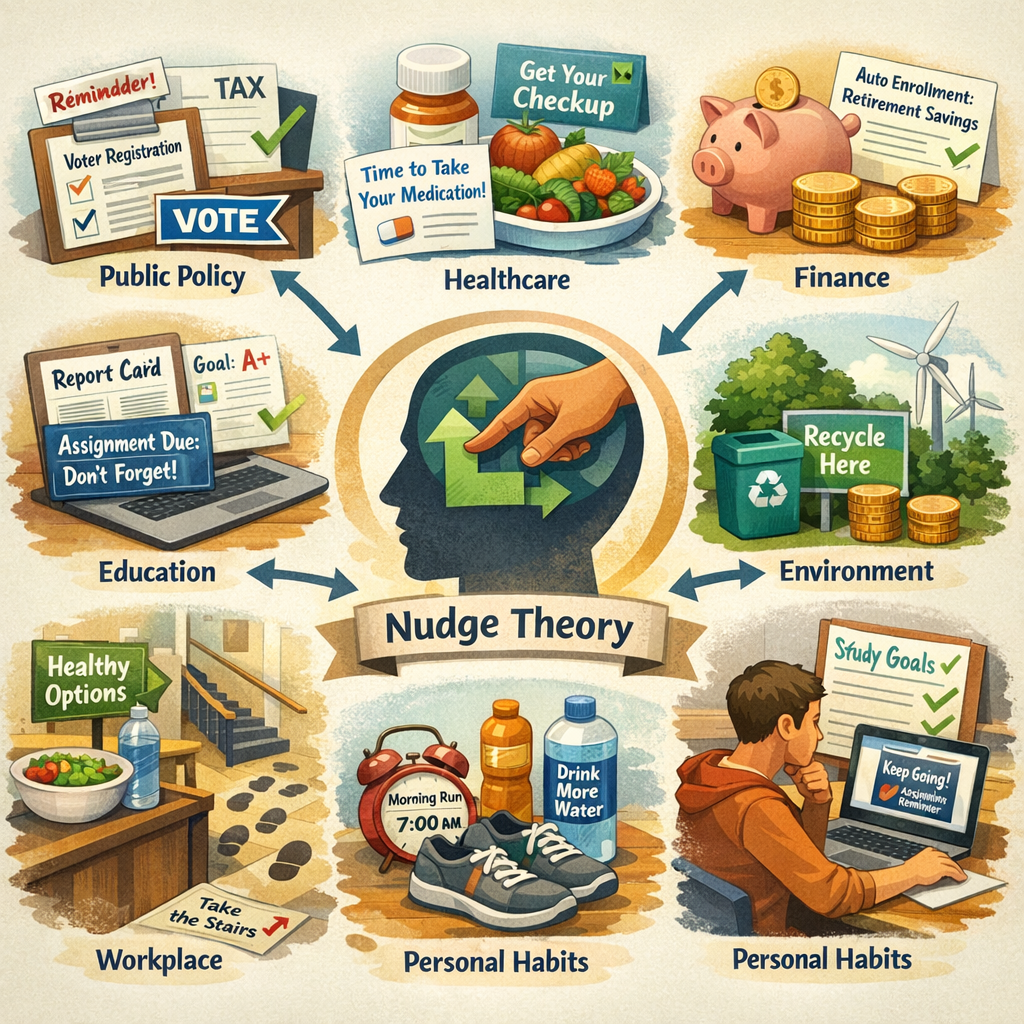
In marketing and everyday life, nudges can help people make more informed, responsible, and beneficial choices by gently shaping the way options are presented without removing freedom of choice. A nudge might encourage someone to choose energy-efficient appliances by clearly displaying long-term cost savings, reduce waste by placing recycling bins in more visible locations, exercise more regularly by setting friendly reminders, or manage screen time by showing daily usage reports and offering simple limits. These small design choices can make healthier, more sustainable, or more practical behaviors easier to notice and easier to follow.
The strength of nudge theory lies in its understanding of human behavior. People often make decisions quickly, based on habit, convenience, emotion, or the way information is framed. Because of this, even minor changes in the environment can influence decision-making. For example, placing healthier foods at eye level in a cafeteria can encourage better eating habits, while making paperless billing the default option can reduce unnecessary paper use. In each case, the individual still has the ability to choose differently, but the preferred choice becomes simpler and more accessible.
The key principle is that nudges should be transparent, respectful, and designed to improve well-being rather than manipulate people for unfair advantage. Ethical nudges should make information clearer, reduce confusion, and support goals that people would reasonably value, such as saving money, protecting the environment, improving health, or using time more wisely. They should not rely on deception, hidden pressure, or exploiting people’s weaknesses.
When applied responsibly, nudge theory offers a practical and powerful way to support better decision-making while maintaining individual autonomy and choice. It can benefit consumers, organizations, communities, and public policy by encouraging positive actions without force or restriction. Ultimately, effective nudges work best when they help people act in line with their own interests and values, making good decisions feel easier, more natural, and more achievable.