







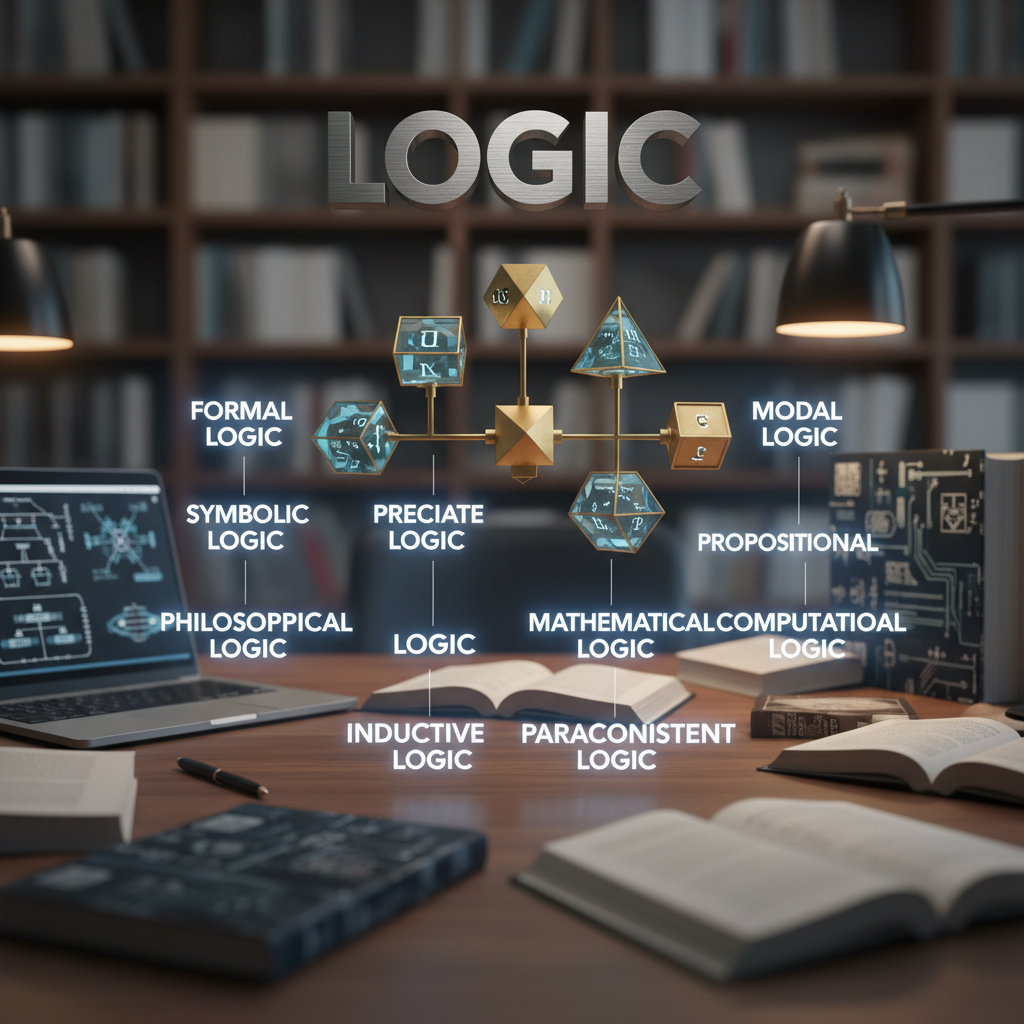
As artificial intelligence systems increasingly grapple with inconsistent data, conflicting instructions, and contradictory knowledge bases, a once-niche corner of formal logic is moving into the spotlight. Paraconsistent logic — a family of non-classical logical systems designed to tolerate contradictions without collapsing into incoherence — is being revisited by computer scientists, philosophers, and AI researchers in 2024 and 2025 as a possible foundation for more robust reasoning machines. The renewed interest, fueled by recent academic publications and conferences, suggests that the decades-old framework pioneered by Brazilian logician Newton da Costa may finally be having its applied moment.
What Is Paraconsistent Logic?
In classical logic, a single contradiction is catastrophic. Under the principle known as ex contradictione quodlibet — “from a contradiction, anything follows” — once a system contains both a proposition and its negation, every statement becomes provable. The system, in effect, explodes. Paraconsistent logics reject this principle of explosion, allowing reasoners to work with contradictory premises without deriving arbitrary conclusions. The approach was developed in detail in the mid-20th century by figures such as Newton da Costa and Stanisław Jaśkowski, and an accessible overview is available through the Stanford Encyclopedia of Philosophy.
For decades, paraconsistent logic remained largely a philosophical curiosity, debated alongside dialetheism — the view that some contradictions are actually true — and championed by logicians like Graham Priest. But the rise of large-scale knowledge graphs, automated theorem provers, and most recently, generative AI systems that frequently produce inconsistent outputs, has given the formalism new practical relevance.
Why It Matters Now
Modern machine learning systems are notorious for producing contradictory statements. A large language model may assert one fact in a paragraph and contradict it in the next; a knowledge base aggregated from millions of sources will inevitably contain conflicting entries. Classical logic-based reasoning engines built on top of these systems risk becoming useless the moment a single inconsistency appears. Paraconsistent frameworks offer a way to keep reasoning under such conditions.
Recent work presented at venues such as the International Joint Conference on Artificial Intelligence has explored how paraconsistent semantics can be embedded in neuro-symbolic systems, allowing AI agents to flag contradictions, isolate them, and continue producing useful inferences from the consistent portions of their knowledge. Researchers have also been examining how paraconsistent annotated logics — a variant developed by da Costa and colleagues with explicit truth-value annotations — can be used in expert systems for medical diagnosis, where conflicting test results are routine.
From Philosophy Departments to Engineering Labs
The trajectory of paraconsistent logic illustrates a broader pattern in the history of formal reasoning: ideas developed for purely philosophical motivations eventually find unexpected engineering applications. Just as modal logic moved from metaphysics into computer science via temporal verification, and intuitionistic logic became foundational to type theory and programming language design, paraconsistent logic is now being adapted for fault-tolerant databases, belief revision systems, and inconsistency-tolerant ontologies in the Semantic Web.
Graham Priest, one of the most prominent contemporary defenders of dialetheism, has long argued that the world itself may contain genuine contradictions — citing paradoxes of self-reference, legal systems with conflicting statutes, and certain interpretations of quantum mechanics. While that metaphysical claim remains controversial, the methodological point that reasoning systems must cope with apparent contradictions is increasingly difficult to dispute. A useful primer on Priest’s broader program can be found through resources like the Internet Encyclopedia of Philosophy.
Open Questions and What to Watch
Significant challenges remain. Paraconsistent logics typically sacrifice some classical inference rules — disjunctive syllogism, for example — and choosing which to give up has both technical and philosophical consequences. Computational complexity is another concern: many paraconsistent reasoning tasks are at least as hard as their classical counterparts, and sometimes harder. There is also no consensus on which paraconsistent system is best suited to which application domain.
Still, as AI safety researchers increasingly emphasize the need for systems that can reason transparently about their own uncertainty and inconsistency, paraconsistent logic seems poised for further integration into mainstream computer science. Watch for new benchmark datasets specifically designed to test inconsistency-tolerant reasoning, additional cross-disciplinary workshops linking logicians with machine learning practitioners, and possible adoption of paraconsistent inference layers in commercial knowledge management products over the next two to three years.
For more deep dives into the frontiers of logic, mathematics, and the sciences, visit and bookmark science.wide-ranging.com for related coverage and ongoing analysis.