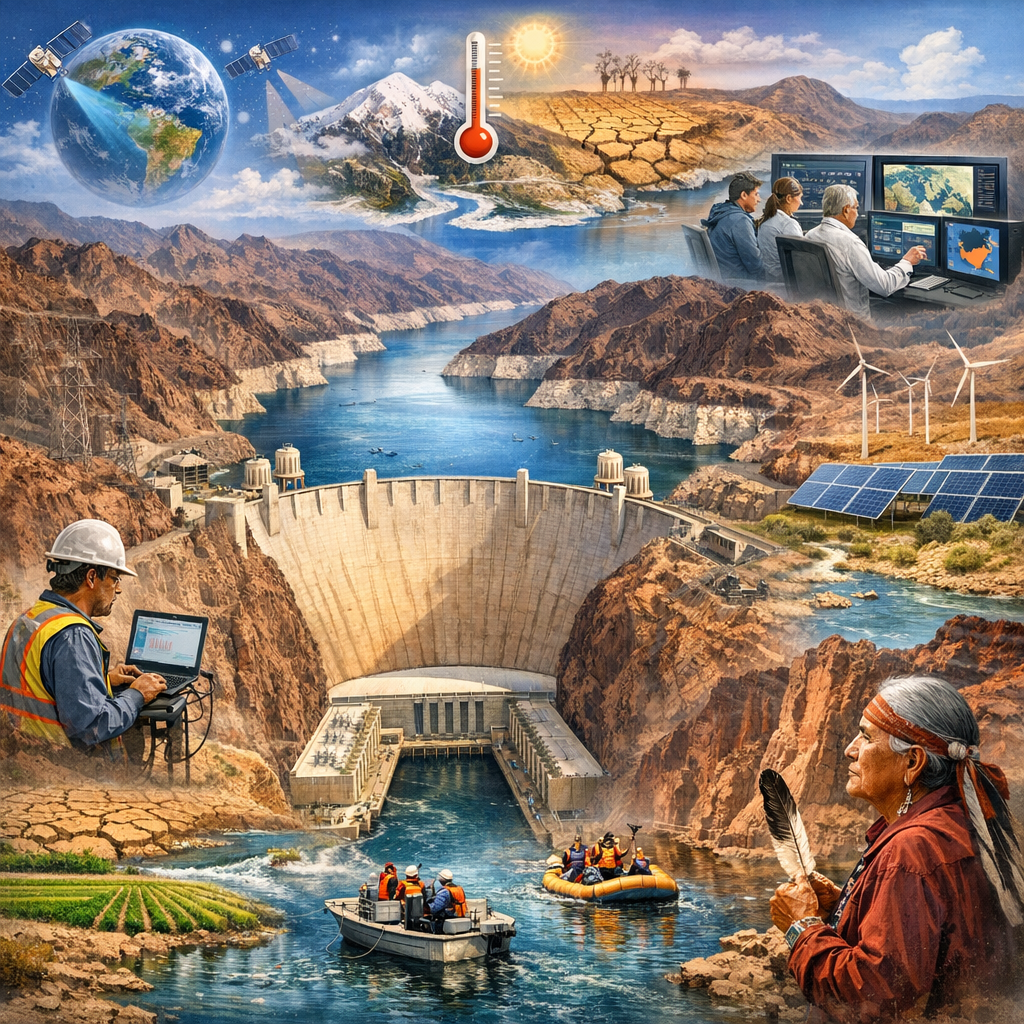







Hoover Dam, the Colorado River, and the latest science news come together in a fascinating and important look at engineering, water management, climate change, and environmental research. Together, they tell a larger story about how people have tried to manage one of the most vital river systems in North America, how that effort transformed the American Southwest, and how new scientific knowledge is now shaping the decisions that will affect future generations. As one of the most recognizable public works projects in the United States, Hoover Dam represents a major achievement in twentieth-century engineering. Built during the Great Depression, it provided jobs during a time of national hardship and became a powerful symbol of human ambition, technical skill, and large-scale public investment. Construction of Hoover Dam began in the early 1930s and was completed in 1936, rising in Black Canyon on the border between Nevada and Arizona. At the time, it was one of the largest and most complex construction projects ever attempted. Engineers, laborers, geologists, surveyors, and planners worked under difficult desert conditions to build a massive concrete arch-gravity dam capable of holding back the force of the Colorado River. Its curved design allows the pressure of the water to be transferred into the canyon walls, while its enormous weight helps keep the structure stable. The result was a dam that not only controlled flooding but also created Lake Mead, one of the largest reservoirs in the United States. Hoover Dam changed the region in dramatic ways. Before the dam was built, the Colorado River was known for unpredictable floods that could damage farms, towns, and transportation routes downstream. By storing and regulating the river’s flow, the dam made it easier to manage water supplies for agriculture, cities, and industry. It also generated hydroelectric power, helping support the growth of places such as Las Vegas, Los Angeles, Phoenix, and other communities across the Southwest. The electricity produced by the dam became part of a larger transformation, allowing desert cities to expand and modern infrastructure to flourish in areas that once seemed difficult to develop. Its massive concrete structure and carefully designed systems continue to show how human innovation can reshape a landscape while also creating new responsibilities for future generations. Hoover Dam is not only a monument to engineering success; it is also a reminder that every major alteration of nature brings long-term consequences. The reservoir behind the dam stores water for dry years, but it also changes the natural flow of the river. Sediment that once traveled downstream is trapped behind the dam, affecting beaches, habitats, and ecosystems farther along the river. Water temperature, seasonal flows, and fish habitats have also been altered. These changes have made the dam a focus not only for engineers and historians, but also for ecologists, climate scientists, and water policy experts. The Colorado River itself is equally important, and in many ways even more central to the story. Flowing through mountains, deserts, canyons, farms, and cities, it is one of the most heavily managed and most closely studied rivers in the world. Its headwaters begin in the Rocky Mountains, where snowpack accumulates during the winter and melts during the spring and summer. From there, the river and its tributaries travel through a vast and varied region, including Colorado, Utah, Arizona, Nevada, California, New Mexico, and Wyoming. The river also crosses into Mexico, where its remaining flow historically reached the Colorado River Delta and the Gulf of California. The Colorado River supplies water to millions of people and supports a wide range of human and natural systems. It provides drinking water for major cities, irrigation for farms, and water for tribal communities whose histories and rights are deeply connected to the river. Agriculture in the Colorado River Basin produces vegetables, fruits, hay, cattle feed, and other crops that support local economies and national food supplies. The river also sustains wildlife habitats, wetlands, riparian forests, and recreation areas. Rafting, boating, fishing, hiking, and tourism all depend in some way on the river and the landscapes it has shaped. Iconic natural places such as the Grand Canyon reveal the river’s power over millions of years, as flowing water carved deep layers of rock and created one of the most famous landscapes on Earth. However, the Colorado River now faces increasing pressure from long-term drought, rising temperatures, population growth, and competing demands for water. Since the early twenty-first century, the basin has experienced one of the driest periods in recorded history, often described by scientists as a megadrought. At the same time, warming temperatures have intensified the problem. Heat causes more water to evaporate from reservoirs, soils, and vegetation, and it can reduce the amount of runoff that reaches the river even when precipitation appears near normal. In other words, the river’s future is not shaped only by how much snow or rain falls, but also by how much water the atmosphere, land, plants, and reservoirs lose before it can be used. Lake Mead, the reservoir created by Hoover Dam, has become one of the clearest visible signs of these challenges. Over the past several decades, its water levels have dropped significantly during dry periods, exposing pale “bathtub rings” along the canyon walls. These marks show where the water once stood and have become a striking symbol of water scarcity in the Southwest. Low reservoir levels can affect hydroelectric power production because less water pressure is available to move through the dam’s turbines. They can also reduce flexibility for water managers, making it harder to balance the needs of cities, farms, ecosystems, and legal water agreements. These challenges make scientific research more essential than ever. Today, scientists use climate models, satellite data, river monitoring, snowpack measurements, groundwater studies, and environmental research to better understand how the Colorado River system is changing. Climate models help researchers explore possible futures under different warming and precipitation scenarios. While no model can predict every detail perfectly, these tools are valuable for identifying long-term trends and risks. Many studies show that the Southwest is likely to face continued warming, and that even modest changes in temperature can have major effects on water availability. Satellite data has become especially useful in modern water science. Satellites can measure snow cover, track changes in vegetation, observe reservoir levels, and help estimate water use across large agricultural areas. Some satellite missions can even detect changes in Earth’s gravity that reveal gains or losses in groundwater storage. This is important because groundwater is often used to supplement river water during droughts, but excessive pumping can lower aquifers and create new long-term problems. By combining satellite observations with data from river gauges, weather stations, and field studies, scientists can build a more complete picture of the basin’s condition. River monitoring also plays a major role in understanding the Colorado River. Stream gauges measure how much water is flowing at different points in the system. Snow sensors in the mountains help estimate how much runoff may arrive in spring and summer. Water quality tests reveal changes in temperature, salinity, nutrients, and pollutants. Ecologists study fish populations, wetlands, insects, birds, and riparian vegetation to understand how changes in flow affect living systems. This research is particularly important below dams, where natural flood cycles have been reduced or altered. In some areas, controlled releases of water are used to mimic certain natural processes, rebuild sandbars, or support habitat, although these efforts must be balanced against limited water supplies. The latest science news about the Colorado River often focuses on the connection between climate change and water management. Researchers increasingly describe the problem not simply as a temporary drought, but as aridification, meaning a longer-term shift toward drier conditions caused in part by rising temperatures. This distinction matters because drought suggests that conditions may return to the old normal, while aridification suggests that water planning must adapt to a new and changing reality. If the river produces less water in the future than it did in the twentieth century, then agreements, infrastructure, and conservation strategies must be updated to reflect that new reality. Decision-makers use scientific findings to plan for water shortages, protect ecosystems, improve conservation efforts, and adapt to a warming climate. Water agencies are working on strategies such as reducing outdoor water use in cities, improving irrigation efficiency, recycling wastewater, banking water underground, restoring habitats, and negotiating new sharing agreements. Some communities have replaced thirsty lawns with desert landscaping, while farmers have adopted more precise irrigation methods or shifted crop choices in certain areas. These solutions are not simple, because water is tied to livelihoods, culture, legal rights, food production, and regional identity. Still, science provides the data needed to make better choices and to understand the consequences of delay. Tribal nations are also central to the future of the Colorado River. Many tribes hold significant water rights, and their communities have long histories along the river and its tributaries. In recent years, there has been growing recognition that tribal perspectives, legal rights, and environmental knowledge must be included more fully in river management. Any serious discussion of the Colorado River’s future must consider not only cities and farms, but also Indigenous communities whose connections to the river are cultural, historical, legal, and spiritual. Hoover Dam remains a powerful symbol within this larger story. It represents confidence in engineering and the belief that human beings can control natural forces for public benefit. At the same time, the Colorado River’s current challenges show that engineering alone is not enough. Dams, reservoirs, canals, and power plants must now be managed with a deeper understanding of climate, ecology, and long-term sustainability. The dam that once stood mainly as a sign of progress now also stands as a reminder of limits: limits to water supply, limits to growth, and limits to the assumption that the future will resemble the past. Together, Hoover Dam, the Colorado River, and modern science reveal how closely engineering, nature, and society are connected. The dam shows what people can build when they combine vision, planning, labor, and technology. The river shows the power of natural systems that support life across vast and diverse landscapes. Science helps connect the two by explaining how the system works, how it is changing, and what choices may lead to a more secure future. They remind us that understanding the past is vital for managing present challenges and preparing wisely for the future. The story of Hoover Dam and the Colorado River is therefore not only about concrete, water, and electricity; it is about responsibility, adaptation, and the need to live more thoughtfully within a changing environment.