






Paraconsistent Logic Gains Renewed Attention as Researchers Tackle AI Contradictions and Quantum Reasoning
A growing wave of academic interest in paraconsistent logic — a non-classical system that allows reasoning even in the presence of contradictions — is reshaping how researchers approach inconsistencies in artificial intelligence, quantum mechanics, and large-scale knowledge databases. Recent scholarship and conference activity in 2024 and 2025 indicate that this once-niche branch of formal logic is moving from the philosophical fringe toward mainstream computer science and applied reasoning systems.
What Is Paraconsistent Logic?
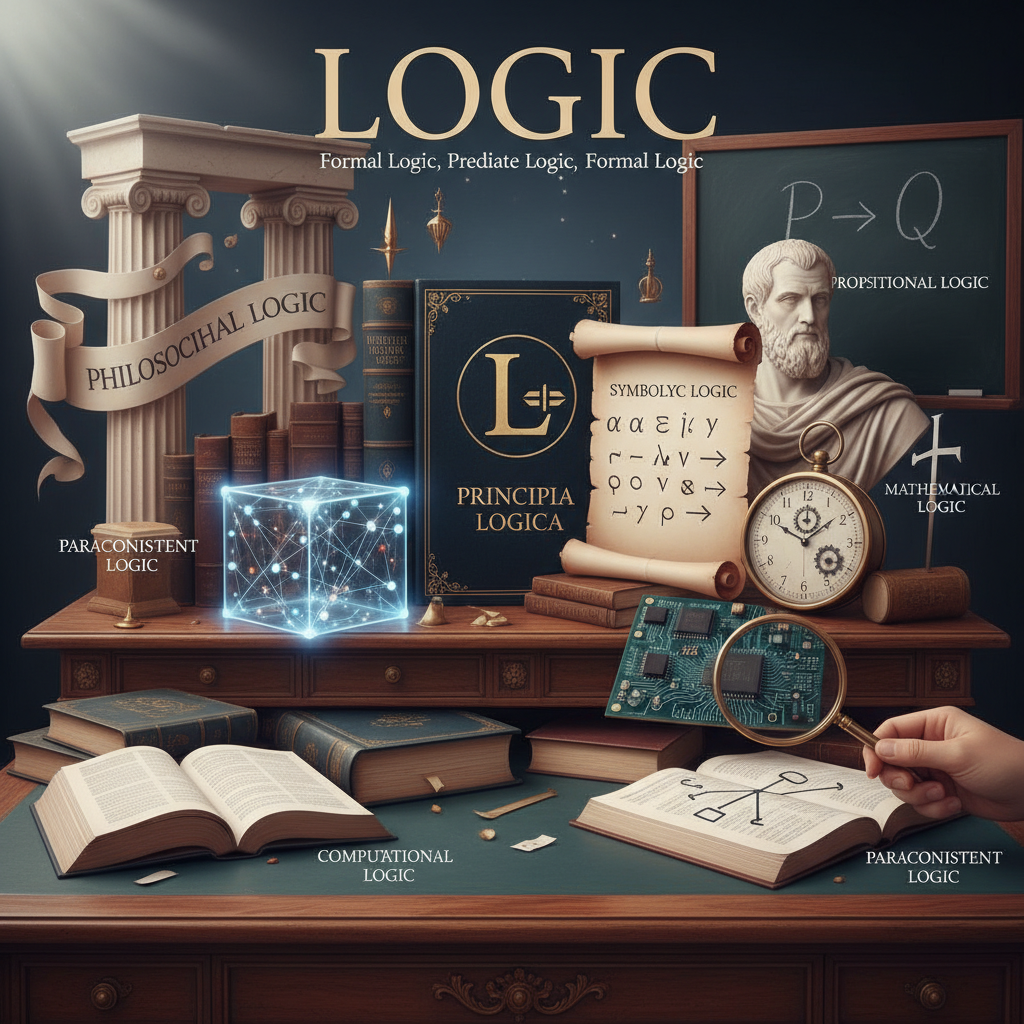
Classical logic adheres to a principle known as ex contradictione quodlibet — from a contradiction, anything follows. In other words, a single contradiction in a classical system renders every statement provable, collapsing the system into triviality. Paraconsistent logic, first formalized in the mid-20th century by thinkers including Polish logician Stanisław Jaśkowski and Brazilian mathematician Newton da Costa, rejects this principle. It permits a controlled tolerance of contradictions, allowing reasoning to continue meaningfully even when conflicting information is present. A thorough overview can be found in the Stanford Encyclopedia of Philosophy’s entry on paraconsistent logic, which traces the field’s history and core motivations.
Why It Matters Now
The renewed momentum behind paraconsistent reasoning is being driven largely by problems in artificial intelligence. Large language models and knowledge graphs frequently ingest contradictory data — a Wikipedia article saying one thing, a scientific paper saying another, a database entry conflicting with both. Under classical logical frameworks, such systems risk producing nonsense, hallucinations, or trivially false outputs. Paraconsistent frameworks offer formal guarantees that reasoning can be preserved even when underlying datasets are inconsistent.
Researchers at institutions including the University of Oxford’s Department of Computer Science and groups affiliated with the Australasian Association for Logic have been publishing on how paraconsistent semantics could underpin more robust automated reasoning agents. The intuition is straightforward: rather than crashing or producing arbitrary outputs when facing contradictory inputs, an AI system equipped with paraconsistent logic can flag the contradiction, isolate it, and continue to draw valid conclusions from the consistent portions of its knowledge base.
Applications Beyond AI
Paraconsistent logic also continues to attract attention in the philosophy of physics. Quantum mechanics famously generates apparent contradictions — a particle being in two states simultaneously, measurement paradoxes, and observer-dependent truths — that strain classical logical interpretation. Logician Graham Priest, perhaps the most prominent advocate of dialetheism (the view that some contradictions are genuinely true), has long argued that paraconsistent frameworks provide a more honest scaffolding for quantum reasoning. His ongoing work, much of it accessible through his academic homepage, continues to influence debates in both metaphysics and mathematical logic.
Legal reasoning is another emerging application. Statutes and case law routinely contain contradictions, yet judges must still decide cases. Computational models of legal reasoning increasingly look to paraconsistent systems to formalize how courts navigate inconsistent precedents without collapsing into incoherence.
The Significance of the Shift
For decades, paraconsistent logic was viewed within mainstream analytic philosophy as a curiosity — interesting but peripheral. The current moment marks a genuine inflection point. As AI systems are deployed in high-stakes domains such as medicine, defense, and finance, the inability of classical logic to gracefully handle real-world inconsistency has become a practical engineering problem, not just a philosophical puzzle. Conferences such as the Indian Conference on Logic and its Applications have featured increasing numbers of papers exploring paraconsistent semantics for machine reasoning.
Critics, however, caution that adopting paraconsistent frameworks comes with trade-offs. Some forms weaken inference rules so substantially that the resulting systems lose useful deductive power. Selecting the right paraconsistent logic for a given application — there are many variants, including LP, relevant logics, and adaptive logics — remains a significant theoretical challenge.
What to Watch Next
Looking ahead, expect to see more interdisciplinary collaborations bridging logicians, computer scientists, and domain experts. Funding agencies have begun supporting research projects aimed at building inconsistency-tolerant reasoning engines, and several open-source projects are working to implement paraconsistent inference layers atop existing knowledge graph platforms. If these efforts succeed, paraconsistent logic could quietly become foundational infrastructure for the next generation of reasoning systems — a shift that would vindicate a tradition long dismissed as exotic.
For more deep dives into the evolving worlds of logic, mathematics, and the sciences, visit science.wide-ranging.com for related articles and ongoing coverage.