



A breakthrough in AI language models represents a major advance in how computers understand and respond to human language. Moving beyond keyword matching and fixed rules, these models better capture context, intent, nuance, and variation, enabling more accurate responses, deeper contextual awareness, and greater value in real-world applications.
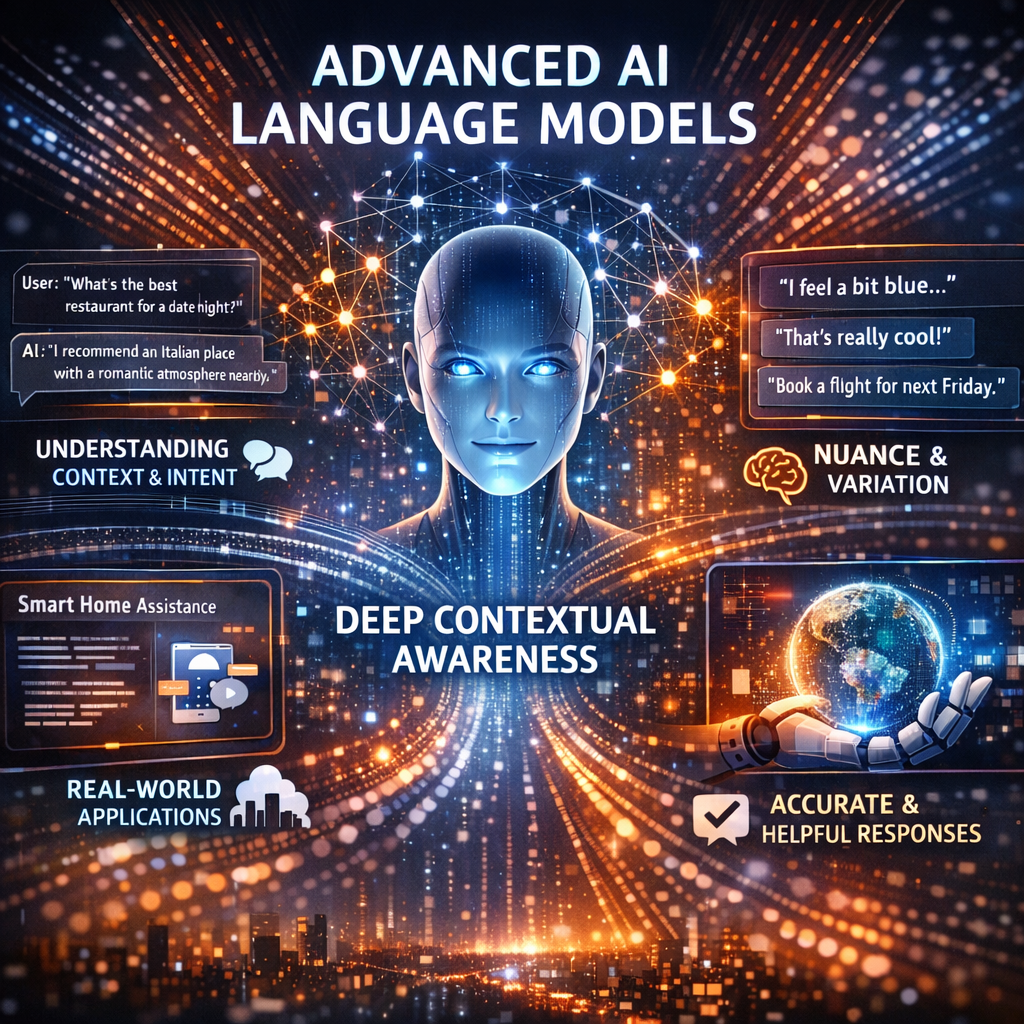
Instead of simply matching words on a surface level or producing generic responses that may only partially address a user’s request, more capable language models can interpret meaning across longer passages, recognize nuance, and respond in a way that better fits the situation. They can distinguish between literal and implied meaning, identify the tone of a question, and adjust their answers depending on whether the user needs a simple explanation, a professional summary, a creative draft, or a step-by-step guide. This ability to follow complex instructions and adapt to different needs makes interactions with technology feel more natural, efficient, and supportive.
One of the most important aspects of this breakthrough is improved context awareness. Human communication depends heavily on context: the same word or phrase can mean different things depending on who is speaking, what has already been said, and what the goal of the conversation is. Earlier systems often struggled when a user’s request required remembering previous details, resolving ambiguity, or understanding the larger purpose behind a prompt. More advanced language models are better able to connect ideas, maintain continuity, and produce responses that reflect the full conversation rather than isolated fragments. This makes them more effective as assistants, collaborators, and information tools.
Greater accuracy is another key improvement. While no AI system is perfect, stronger language models can more reliably identify relevant information, organize it clearly, and present it in a way that users can understand. They are better at avoiding overly vague responses, recognizing when a question requires caution, and offering structured explanations. In practical terms, this means users can receive help that is more focused, coherent, and useful. Whether someone is asking for a business email, a study plan, a summary of a report, or an explanation of a technical concept, a more advanced model can produce content that is closer to what the user actually needs.
These improvements can have a meaningful impact across many fields where clear communication and intelligent information processing are essential. Writing assistance is one of the most immediate and visible areas of benefit. AI can help users organize scattered ideas, outline arguments, refine tone, improve grammar, and create polished content more quickly. A student might use it to structure an essay, a professional might use it to draft a proposal, and a small business owner might use it to create product descriptions, newsletters, or customer messages. The value is not only in producing text faster, but also in helping people communicate with greater clarity and confidence.
In writing, tone and audience matter just as much as correctness. A message intended for a formal business partner should sound different from a message sent to a friend, a customer, or a classroom audience. More advanced language models can help adjust style appropriately, making a sentence more concise, more persuasive, more friendly, or more professional depending on the desired result. They can also suggest alternative phrasing, remove unnecessary repetition, and improve the flow of paragraphs. For people who find writing stressful or time-consuming, this support can reduce friction and make communication feel more manageable.
Translation is another field where improved language models can make a significant difference. Traditional translation tools often focused on converting words or phrases from one language to another, but effective translation requires much more than literal accuracy. Language carries cultural context, idioms, tone, formality, and emotional intent. A more advanced AI system can help preserve not only the basic meaning of a message but also its style and purpose. This can make communication between languages smoother, more respectful, and more natural. For international teams, travelers, educators, businesses, and families communicating across language barriers, better translation can help build understanding and reduce confusion.
In education, the potential is especially broad. Language models can support personalized tutoring by adapting explanations to a learner’s level, pace, and preferred style. If a student does not understand a concept the first time, the AI can rephrase the explanation, provide examples, break the idea into smaller steps, or generate practice questions. It can help learners review material, prepare for exams, summarize readings, and receive feedback on written work. This type of support can be especially valuable for students who need extra practice, students learning in a second language, or learners who benefit from immediate guidance outside traditional classroom hours.
The role of AI in education is not limited to giving answers. Used thoughtfully, it can encourage curiosity and independent learning. For example, a student studying science could ask for a simple explanation of photosynthesis, then request a more advanced version, then ask for a quiz to test understanding. A language learner could practice conversation, receive grammar corrections, and explore vocabulary in context. A teacher could use AI to create lesson plans, discussion prompts, worksheets, or differentiated materials for students with different needs. In this way, language models can support both learners and educators by making educational resources more flexible and accessible.
The benefits also extend to customer support, where clear and timely communication is essential. Companies can use AI systems to answer common questions, guide customers through troubleshooting steps, summarize service requests, and route more complex issues to human representatives. This can reduce wait times and allow support teams to focus on cases that require judgment, empathy, or specialized knowledge. When designed responsibly, AI-powered customer support can provide consistent information while still recognizing when a situation should be escalated to a person. This balance can improve both efficiency and customer satisfaction.
Research is another area where advanced language models can be highly useful. Researchers, analysts, and professionals often face large amounts of text, including articles, reports, transcripts, records, and technical documents. AI can help summarize long materials, extract key points, compare arguments, identify patterns, and generate questions for further investigation. This does not replace careful human review, but it can make the early stages of research faster and more organized. By helping people process information more efficiently, language models can support deeper analysis and more informed decision-making.
Healthcare administration can also benefit from improved language technologies. Much of healthcare involves documentation, communication, scheduling, insurance forms, patient instructions, and summaries of clinical information. AI language models can help reduce administrative burden by drafting messages, organizing notes, simplifying complex medical language for patients, and assisting with routine paperwork. In a field where professionals are often pressed for time, these tools can help improve clarity and reduce repetitive work. It is important, however, that such systems be used with strong privacy protections, careful oversight, and appropriate safeguards, especially when sensitive health information is involved.
In business communication, language models can support a wide range of tasks. Teams can use AI to summarize meetings, draft reports, prepare presentations, analyze feedback, write internal updates, and improve communication across departments. A manager might ask for a concise summary of a long document, while a marketing team might request variations of a campaign message for different audiences. Human judgment remains essential, particularly for strategy, ethics, and final approval, but AI can speed up routine tasks and help professionals focus on higher-value work. This can be especially helpful for small teams that need to accomplish more with limited resources.
Software development is another field where language models are becoming increasingly useful. Developers can use AI to explain code, suggest improvements, draft documentation, generate test cases, and help troubleshoot errors. For beginners, AI can make programming concepts easier to understand by translating technical language into clearer explanations. For experienced developers, it can save time by assisting with repetitive coding tasks or helping review unfamiliar codebases. While AI-generated code still needs to be tested and verified, language models can act as a helpful companion in the development process, supporting productivity and learning.
Accessibility tools may be among the most meaningful applications of advanced language models. AI can help people with disabilities communicate, read, write, and navigate information more easily. It can summarize complex documents in plain language, convert speech into text, generate alternative wording, assist with reading comprehension, and support people who have difficulty typing or organizing written communication. For individuals with visual impairments, cognitive differences, language-related challenges, or mobility limitations, better language technology can make digital environments more inclusive. By reducing barriers to information and expression, these tools can help more people participate fully in education, work, and daily life.
Another important advantage is the ability to summarize and organize information. Modern life produces an overwhelming amount of text: emails, articles, policy documents, manuals, chat logs, meeting notes, and online discussions. Language models can help users quickly understand what matters most by creating summaries, highlighting decisions, listing action items, or explaining complicated material in simpler terms. This can save time and reduce information overload. For busy professionals, students, researchers, and everyday users, the ability to turn large amounts of text into clear, useful insights is a powerful benefit.
At the same time, the continued improvement of language models raises important questions about responsible use. Accuracy, fairness, privacy, transparency, and accountability are essential considerations. AI systems can sometimes produce incorrect information, reflect biases in training data, or sound confident even when uncertain. Because of this, users should treat AI as a powerful tool rather than an unquestionable authority. Developers, companies, educators, and policymakers all have a role to play in ensuring these systems are used safely and ethically. Clear guidelines, human oversight, careful evaluation, and ongoing improvement are necessary to build trust.
As these systems continue to improve, they have the potential to make knowledge easier to access, communication more inclusive, and digital tools more responsive to human needs. A well-designed language model can help bridge gaps between experts and non-experts, between speakers of different languages, and between people with different levels of access to education or professional support. It can help turn complex information into understandable guidance, support creativity, and reduce the time spent on repetitive communication tasks. These changes may not replace human expertise, empathy, or judgment, but they can extend human capabilities in valuable ways.
Ultimately, an AI language model breakthrough is significant because language is central to nearly everything people do. We use language to learn, teach, persuade, collaborate, solve problems, share stories, and build relationships. When computers become better at working with language, they become better at supporting many parts of human life. The most promising future is one in which AI systems serve as helpful partners: tools that enhance understanding, improve productivity, encourage creativity, and make information more accessible while remaining guided by human values and responsible oversight. In that sense, progress in language modeling is not only a technical achievement, but also a step toward more natural, useful, and human-centered technology.