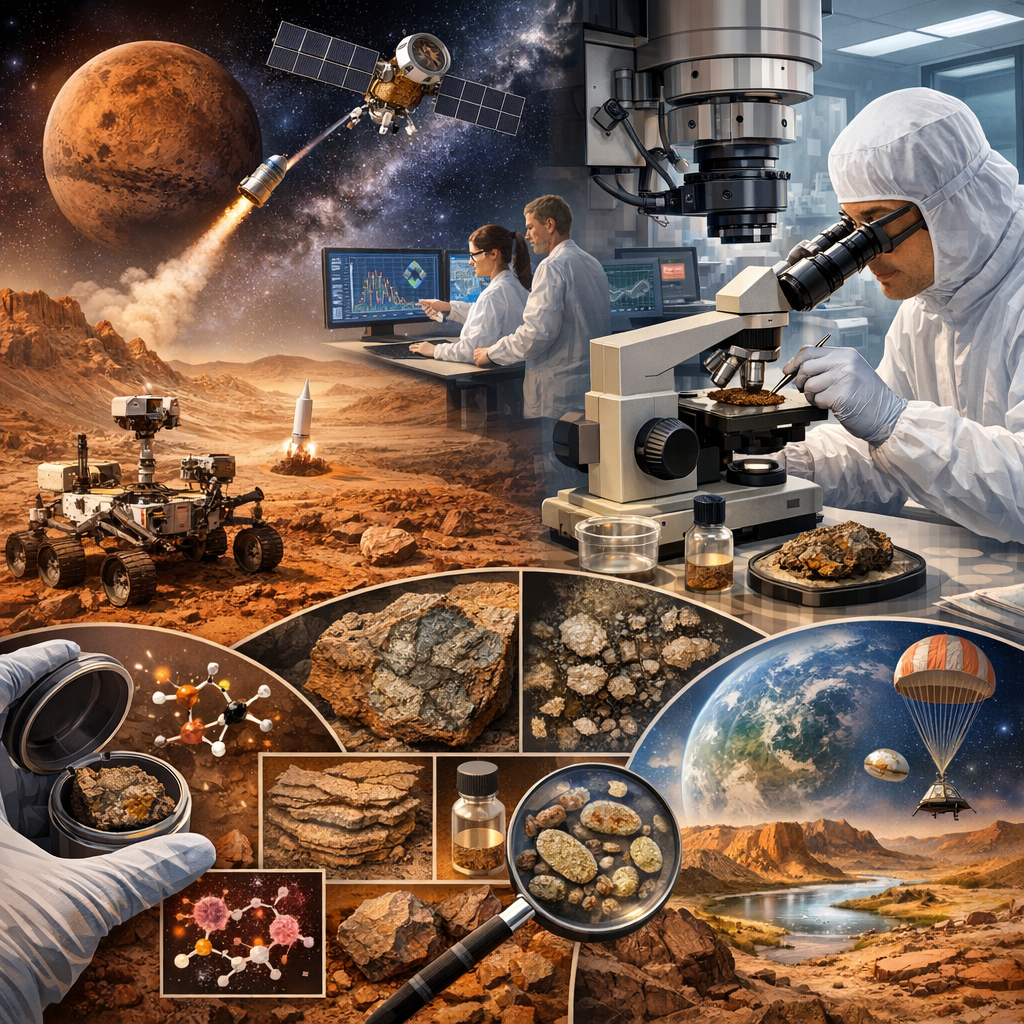







It represents a major step beyond simply sending robotic spacecraft to observe the Red Planet from orbit or explore its surface with rovers. Instead, the campaign aims to place actual Martian material into the hands of scientists, allowing them to examine it with the most advanced laboratory instruments available on Earth. Such instruments are often too large, delicate, power-hungry, or complex to send on a spacecraft, but they can reveal details about a sample’s chemistry, mineral structure, age, and possible biological significance with extraordinary precision.
A central goal of Mars Sample Return is to help scientists better understand the planet’s geological history. Mars preserves ancient rocks and landforms that may date back billions of years, offering clues about a time when the planet likely had rivers, lakes, groundwater, and a thicker atmosphere. By studying returned samples, researchers could determine when certain minerals formed, how long water may have been present, and what environmental conditions existed in the distant past. These findings would help scientists reconstruct how Mars evolved from a warmer, wetter world into the cold, dry, dusty planet seen today.
The campaign is also closely connected to the search for possible signs of ancient microbial life. NASA’s Perseverance rover, which landed in Jezero Crater in 2021, has been collecting and sealing samples from rocks that formed in an ancient lake and river delta environment. Such locations are considered promising because, on Earth, water-rich environments can preserve chemical and physical traces of life. If Mars ever supported microscopic organisms, carefully chosen samples from these ancient deposits may contain subtle evidence, such as organic molecules, mineral patterns, or textures that require detailed laboratory analysis to interpret.
In addition to rocks and soil, atmospheric samples could provide valuable information about Mars’s climate, weather, and chemical processes. Comparing these materials with data gathered by orbiters, landers, and rovers would give scientists a more complete picture of the planet as a whole. Returned samples could also improve preparation for future human missions by helping researchers understand surface hazards, dust properties, and local resources.
Because of its complexity, Mars Sample Return is considered one of the most ambitious projects in planetary exploration. It involves collecting samples on Mars, launching them from the Martian surface, capturing them in orbit, and safely delivering them to Earth under strict containment and protection procedures. If successful, the campaign would provide a scientific treasure that could be studied for decades, allowing future generations to revisit the same samples with new technologies and new questions. In this way, Mars Sample Return could transform humanity’s understanding of Mars, the history of habitability in the solar system, and the possibility that life once existed beyond Earth.