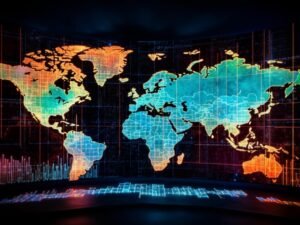





A new wave of remote sensing research published in late 2024 has shown that permafrost across the Arctic is thawing far more unevenly — and in many regions far faster — than previous climate models predicted. Using a combination of satellite radar, optical imagery, and ground-based sensors, scientists have mapped abrupt thaw features such as thermokarst lakes, retrogressive thaw slumps, and ground subsidence across vast stretches of Siberia, Alaska, and northern Canada. The findings, published in part through Nature Climate Change, suggest that the carbon feedback from thawing permafrost may already be outpacing the projections used in major IPCC assessments.
Permafrost — ground that remains frozen for at least two consecutive years — underlies roughly a quarter of the Northern Hemisphere’s land surface. Locked within it is an estimated 1,500 billion tonnes of organic carbon, nearly twice the amount currently in Earth’s atmosphere. When permafrost thaws, microbes break down previously frozen plant and animal matter, releasing carbon dioxide and methane. For decades, researchers assumed this process would unfold gradually as the climate warmed. But the new generation of remote sensing tools is revealing something more alarming: abrupt, localized collapses that can transform landscapes within a single summer season.
How Remote Sensing Changed the Picture
The breakthrough has come from synthetic aperture radar (SAR) missions such as the European Space Agency’s Sentinel-1 constellation, which can detect millimetre-scale ground deformation regardless of cloud cover or polar darkness. By combining SAR interferometry with high-resolution optical imagery from Landsat and Planet’s CubeSat fleet, geographers can now build year-on-year maps of where ground is sinking, fracturing, or collapsing. According to ESA’s Earth Observation programme, these techniques have made it possible to monitor remote tundra regions that were previously inaccessible to systematic study.
Dr. Ingmar Nitze of the Alfred Wegener Institute, whose team has contributed to the Permafrost_cci project, has noted that abrupt thaw features were “essentially invisible” in earlier coarse-resolution datasets. His group’s findings suggest that as much as 20 percent of the permafrost zone may be vulnerable to abrupt thaw — a process that could double the carbon emissions from these regions compared with gradual thaw alone.
Why This Matters Beyond the Arctic
The implications of these maps extend well beyond polar science. Thawing permafrost is already destabilizing infrastructure across the Arctic, from the Trans-Alaska Pipeline to Russian rail lines and Indigenous community housing. A 2023 assessment by the Arctic Council estimated that by mid-century, nearly 70 percent of Arctic infrastructure will sit on ground at risk of significant thaw subsidence, with cumulative damages potentially exceeding tens of billions of dollars.
There are also profound consequences for global climate governance. If permafrost emissions are larger and more abrupt than current models assume, then the carbon budgets used to define national climate targets — including those tied to the 1.5°C goal of the Paris Agreement — may need substantial revision. Some researchers argue that permafrost should be treated as a separate, non-anthropogenic emissions stream, requiring deeper cuts elsewhere to compensate.
Indigenous Knowledge and Ground-Truthing
Importantly, the latest research has increasingly incorporated observations from Indigenous communities, who have documented landscape changes — slumping riverbanks, vanishing lakes, unstable ice cellars — for generations. Programs such as the SIKU platform in Canada and community-based monitoring networks in Alaska are providing ground-truth data that complements satellite observations, helping scientists distinguish seasonal variability from long-term transformation.
What to Watch Next
The next several years will be critical. NASA’s upcoming NISAR mission, a joint project with the Indian Space Research Organisation, is expected to deliver unprecedented L-band radar coverage of polar regions when it launches, dramatically improving our ability to detect subsurface change. Meanwhile, expanded methane-monitoring satellites such as MethaneSAT will help quantify exactly how much of the gas is escaping from thawing soils and Arctic lakes. Together, these tools promise a clearer — and likely more sobering — picture of how quickly the cryosphere is unravelling.
For policymakers, the message from the remote sensing community is increasingly direct: the Arctic is not warming in slow motion. It is changing in pulses, patches, and sudden collapses that satellites are only now able to see in full.
For more in-depth coverage of climate science, geography, and Earth observation, visit science.wide-ranging.com for related reporting and analysis.